
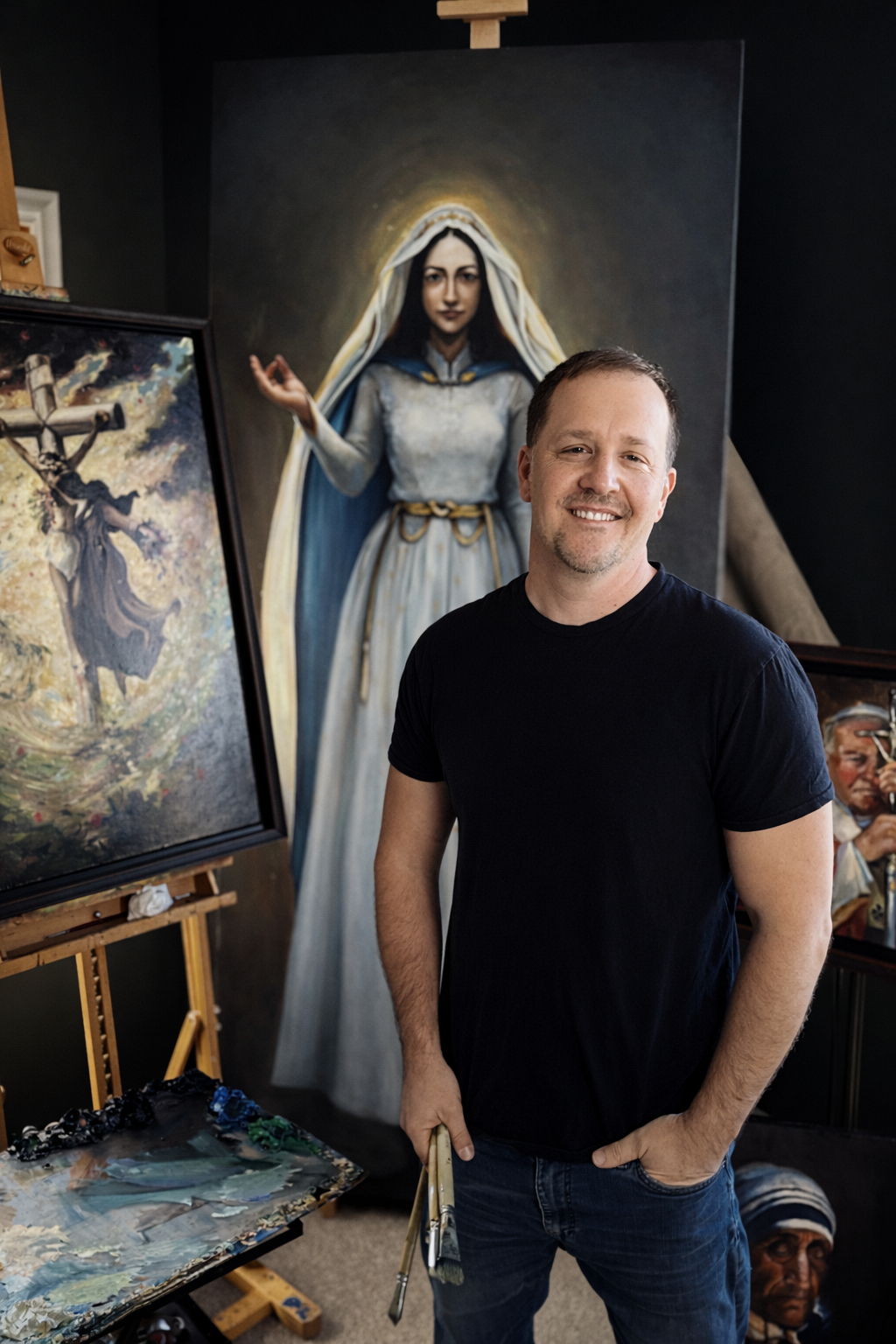
About the Work
Within the Church’s tradition, sacred art has always been a form of visual theology, giving form to how the faith is encountered, received, and lived.
I believe sacred art must gather up the whole of that tradition and speak it anew. The answer to evangelizing the culture is not simply to look backward or recreate the visual language of another age. The artist must receive the tradition deeply, listen to the Spirit, and remain attentive to the lived experience and needs of the people before him.
Sacred art should be ever ancient and ever new: unmistakably rooted in the faith of the Church, yet alive and capable of speaking to the way people see and experience the world today.
My work exists to serve that mission, creating sacred art grounded in beauty and theological truth that supports worship, forms the Christian imagination, and helps dispose people toward an encounter with Christ.
— Michael
Biography
Michael Corsini is a Catholic sacred artist whose work brings together a lifelong formation in art, theology, prayer, and evangelization.
He studied illustration at the Ringling School of Art and Design before spending five years in formation with the Franciscan Friars of the Renewal. His years in religious life were centered on prayer, the Eucharist, fraternity, evangelization, and service to the poor. He also began seminary formation and later earned a Master of Theological Studies from the Pontifical John Paul II Institute for Studies on Marriage and Family in Washington, D.C.
For more than twenty years, Michael has continued to serve the Church through sacred music, Eucharistic worship, retreats, parish ministry, and evangelization. Over time, these experiences converged with his artistic vocation and became foundational to the way he approaches sacred art.
Michael understands sacred art as visual theology. Each commission begins not simply with the question of what should be painted, but with the particular life and mission of the community for whom the work is being created.
He believes that a parish named for a saint is drawn in a particular way into the mission of its patron, sharing in the charisms through which that saint served Christ and the Church. Sacred art can help make that identity visible, reminding a parish not only who its patron was, but who its people are being called to become.
Each work is developed through theological discernment, collaboration with clergy and parish leadership, and careful attention to the liturgy and architecture of the worship space. The goal is not simply to decorate a church, but to create something that can support prayer, deepen worship, and become part of the spiritual inheritance of a community.
Artistically, Michael’s work is informed by painters including John Singer Sargent, Joaquín Sorolla, Nicolai Fechin, and Ilya Repin. Their attention to light, atmosphere, gesture, and the human figure influences his work not as stylistic imitation, but as part of a larger artistic inheritance.
His aim is to create sacred art that belongs fully within the great tradition of the Church without appearing to have simply come from another century or a museum. The work should be rooted in what has been handed down while speaking through a visual language that is immediate, human, and alive.
In many ways, Michael’s work as a sacred artist continues the same mission that first drew him more deeply into the life of the Church: to place Christ before people and invite them into an encounter with Him.
“In beautiful things, God is known not only by reason but by delight.”
— Saint Bonaventure, Commentary on the Sentences